

pharmacogenomics (PGX)
Precision Healthcare
Choose Your Pathway
Manchester University offers graduate pharmacogenomics programs for recent science graduates, practicing healthcare professionals, pharmaceutical and biotechnology professionals, laboratory scientists, and Manchester PharmD students. Whether you are beginning your career or expanding an established one, we offer a pathway designed to meet your goals. Choose from full-time, on-campus
and flexible online programs designed to fit different career goals and life circumstances.
Our programs prepare students and professionals from healthcare, laboratory science, pharmaceutical and biotechnology industries, and the biological sciences to lead the integration of pharmacogenomics into patient care, research, and precision medicine. Students learn to interpret pharmacogenomic data, evaluate gene-drug interactions, and apply precision medicine to clinical scenarios.
Explore Our PGx Degree Pathways
On-site MS in PGx
Designed for recent graduates seeking intensive, full-time study before entering medical, pharmacy,dental, or graduate school, the On-campus MS provides comprehensive education inpharmacogenomics with extensive laboratory and research experience. The 31 credit-hour programprovides a comprehensive education into the depth and breadth of PGx knowledge and clinicalapplication. Students gain hands-on laboratory and research experience over the 1-year program. TheMay start allows students to complete the program in one year before beginning medical, pharmacy,dental, or other health professions programs
Online MS in PGx
Designed for working professionals including physicians, pharmacists, nurses, physician assistants,laboratory scientists, pharmaceutical and biotechnology professionals, and professionals working ingenetic testing. This flexible online program allows students to advance their expertise withoutinterrupting their careers. The 31 credit-hour program is 100% online and asynchronous offeringflexible, interactive learning for working professionals. The program is completed over 2 years with fall,spring and summer start dates.
BS/MS 3+1
For students looking to pursue careers in healthcare professions or a clinical lab career, Manchester offers a unique 3+1 dual degree program that combines the BS in Biology-Chemistry degree with a Master’s in Pharmacogenomics. Students enrolled in the BS in Biology-Chemistry degree apply in their sophomore year for this dual degree program and complete 12 credits of pharmacogenomic coursework during their junior year. Students transition to graduate students on the Fort Wayne site in their senior year.
This pathway is designed to help students transition confidently into health professional degree programs or clinical laboratory careers.
PharmD/PGx Pathways
For students looking to develop advanced expertise in pharmacogenomics while earning their PharmD, Manchester University offers two pathways: a PharmD/MS or a PharmD/Graduate Certificate in PGx.These pathways are completed in the same timeframe as the PharmD, with PGx courses completed primarily during the summer semester.
Students in the PharmD/MS complete 26 credit-hours of PGx courses with 5 credit-hours of PharmD coursework counted towards the MS degree (31 credit-hours total). PharmD/MS students are eligible for PGx-focused APPE rotations in their fourth year. The PharmD/Graduate Certificate requires completion of 13 credit-hours of PGx courses.
These pathways prepare graduates for PGx-focused clinical practice, residency training, precision medicine initiatives, and emerging career opportunities across healthcare and industry.
Graduate Certificate in PGx
The Graduate Certificate in Pharmacogenomics is designed for practicing healthcare professionals,laboratory scientists, pharmaceutical and biotechnology professionals, and others seeking focusedtraining in precision medicine without completing a full master’s degree. The 13 credit-hour program iscomprised of courses focused on the depth and breadth of pharmacogenomics, so that practitionerscan build their competencies and apply important foundational knowledge about PGx to their practice.
The program is delivered 100% online asynchronously. All certificate courses apply toward the Master ofScience in Pharmacogenomics should students choose to continue their education.
View Technical Requirements
Recommended Computer
For the best experience, we recommend using:
- A Windows or Mac laptop or desktop computer
- A computer purchased in the last 5-6 years
- The most current version of Windows or macOS
If you’re unsure whether your computer is new enough, it probably is if you purchased it within the last several years.
Internet Access
You’ll need reliable high-speed internet to:
- Watch course videos
- Participate in virtual meetings
- Submit assignments
- Complete online exams
Whenever possible, use a home internet connection instead of cellular data.
Webcam and Microphone
Some online courses may require students to:
- Participate in virtual meetings
- Record presentations
- Meet with instructors
A built-in webcam and microphone are perfectly fine.
Headphones are also recommended if you’ll be studying in a public or shared spaces.
Required Software
Manchester University provides access to several software programs at no additional cost, including:
- Microsoft 365
- Adobe Acrobat
Additional software may be required for certain courses or programs. Your instructor will let you know before you need it.
Chromebooks and Tablets
Chromebooks, tablets, and smartphones can be helpful for:
- Reading course materials
- Checking announcements
- Viewing grades
However, they should not be your primary device for completing coursework. Some required software and assignments may not work correctly on these devices.
Detailed Technical Specifications (Optional)
For students who would like additional technical details, the following specifications are recommended:
| Component | Recommendation |
| Operating System | Windows 11 or current macOS |
| Processor | Intel Core i5, AMD Ryzen 5, or Apple M1/M2 (or newer) |
| Memory (RAM) | 8 GB minimum (16 GB recommended) |
| Storage | 256 GB SSD minimum |
| Internet Speed | 10-25 Mbps download, 3-5 Mbps upload |
| Webcam | 720p or better |
| Browser | Latest version of Chrome, Edge, Firefox, or Safari |
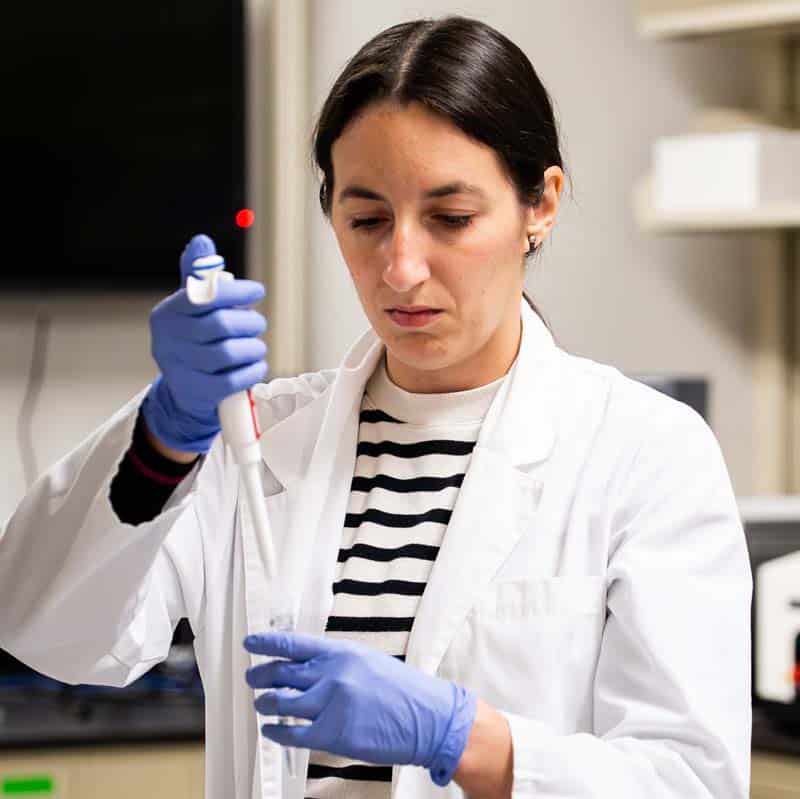
About MU Pharmacogenomics
Fast Facts
Admissions/Prerequisites
Master of Science (MS) in Pharmacogenomics
- 31 Credit Hours
Graduate Certificate
- 13 Credit Hours
- 5-6 Courses
BS / MS 3+1 Program
- BS in Biology-Chemistry
- MS in Pharmacogenomics
- ~140 Credits
Learning Environment
- Fort Wayne
- Online
Prerequisites
- Bachelors of Science Degree
Why Choose MU for Your MS in Pharmacogenomics?
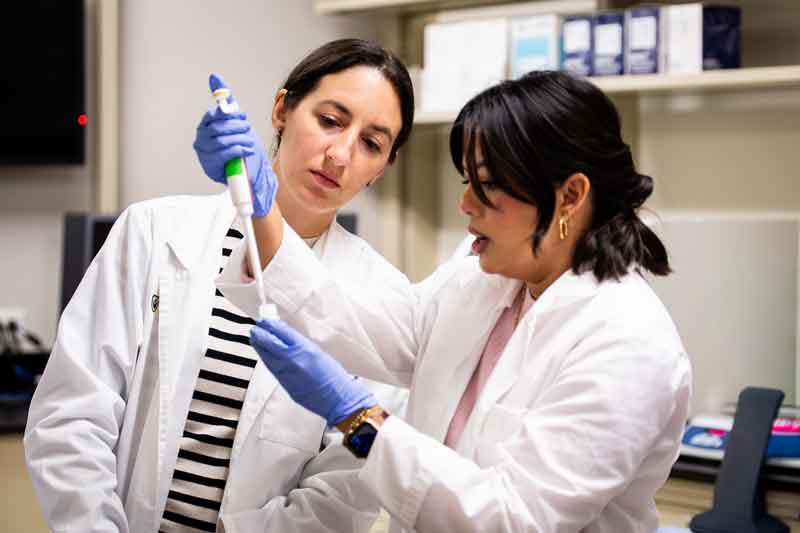
Nation’s First PGx Master’s Program
Manchester pioneered the first PGx master’s program in the U.S., building a legacy of leadership, innovation, and academic excellence in personalized medicine.
Expert Faculty & Research Mentorship
Learn directly from faculty who lead research and apply PGx in real-world settings, offering mentorship in both clinical and lab-based career paths.
Small Class Sizes, Big Impact
With a 10:1 student-faculty ratio, our small cohorts offer personalized instruction, supportive advising, and a strong sense of community.
State-of-the-Art Lab Access
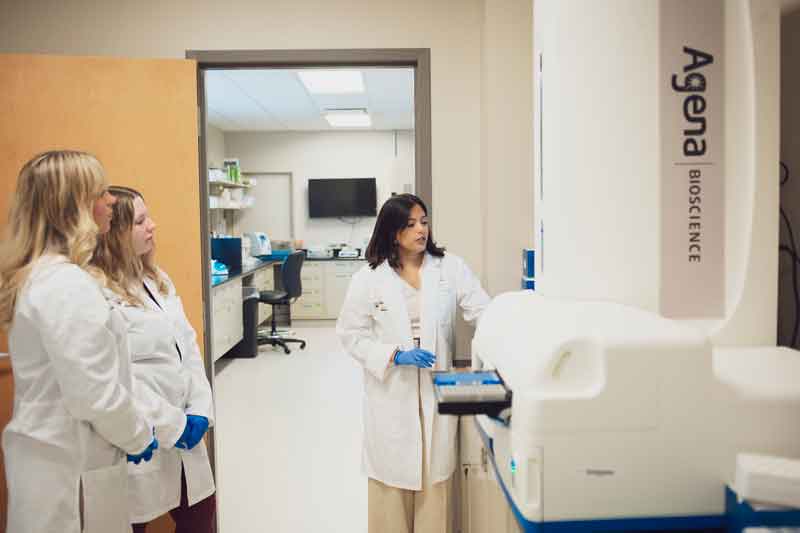
Gain hands-on experience using cutting-edge PGx tools like the Agena MassARRAY and QuantStudio 12 in our dedicated lab courses.
Dual-Degree Pharm.D. Option
Stand out by earning your Pharm.D. and MS in PGx simultaneously—graduate with two powerful degrees in the time it takes to earn one.
What You Can Do With Your Pharmacogenomics Degree
Laboratory Technician
Support genetic testing, drug development, and clinical PGx research projects.
Medical Science Liaison
Bridge communication between pharma companies and healthcare professionals using PGx.
Genetic Counselor (with advanced training)
Guide patients and clinicians on medication based on genetic profiles.
Ph.D. or Professional Degree Candidate
Pursue further education in pharmacy, medicine, or biomedical sciences.

Curriculum
The comprehensive coursework of your degree in pharmacogenomics encompass 25 required credit hours and 6 elective credit hours of instruction.
On-site Course Schedule
Required Courses – 25 Credits
Summer Semester
- Biostatistics (1st half, online)- 3 credits*
- Introduction to PGx (2nd half, on campus)- 2 credits
- Human Genetics (2nd half, online) – 3 credits
Fall Semester
- Applied Pharmacogenomics- 3 credits
- Bioinformatics (online)- 3 credits
- Adv. Molecular Biology – 2 credits
Spring Semester
- Advanced Pharmacokinetics- 2 credits
- Research Responsibility and Ethics (online)- 1 credit
- The Gene-Drug Pipeline- 3 credits
- Pharmacology – 3 credits
Elective Courses – 6 Credits
- Pharmacogenomics in Neurologic and Cardiovascular Disorders- 3 credits
- Pharmacogenomics in Oncology- 2 credits
- Research and Innovative Practice Seminar- 1 credit
- Pharmacogenomics Laboratory 1 (2nd half, on campus)- 1 credit
- Pharmacogenomics Laboratory 2- 2 credits
- Pharmacogenomics Laboratory 3- 2 credits
*Students are not required to be on-campus in Fort Wayne, IN, until the start of the second half of the summer semester.
Online Course Schedule
Required Courses – 25 credits
- Introduction to Pharmacogenomics – 2 credits
- Pharmacology- 3 credits
- Advanced Pharmacokinetics- 2 credits
- Human Genetics- 3 credits
- Biostatistics- 3 credits
- Advanced Molecular Biology – 2 credits
- Bioinformatics- 3 credits
- Applied Pharmacogenomics- 3 credits
- Research Responsibilities and Ethics- 1 credit
- The Gene-Drug Pipeline- 3 credits
Elective Courses – 6 credits required
- Pharmacogenomics in Neurologic and Cardiovascular Disorders- 3 credits
- Pharmacogenomics in Oncology- 2 credits
- Research and Innovative Practice Seminar- 1 credit
- Pharmacogenomics Laboratory Intensive (1 week course on campus)- 1 credit
Each online course is 7 – 8 weeks long and asynchronous. Courses are typically taken one at a time with two courses per semester. Students work with the Program Director to plan an individual course sequence to fit theireducational needs. Students may be able to transfer up to 8 credit hours of previous graduate-level coursework to fulfill requirements of the Master’s in Pharmacogenomics.
Graduate Certificate Course Schedule
Required Courses | 8 Credits
- Introduction to Pharmacogenomics – 2 credits
- Applied Pharmacogenomics I – 3 credits
- Pharmacogenomics in Neurologic and Cardiovascular Disorders – 3 credits
Elective Courses | 5 Credits
- Advance Pharmacokinetics – 2 credits
- Human Genetics – 3 credits
- Biostatistics – 3 credits
- Advanced Molecular Biology – 2 credits
- Pharmacology – 3 credits
- Research Responsibilities and Ethics – 1 credit
- Bioinformatics – 3 credits
- The Gene-Drug Pipeline – 2 credits
- Pharmacogenomics in Oncology – 2 credits
- Research and Innovative Practice Seminar – 1 credit
- Pharmacogenomics Laboratory Intensive (1 week course) – 1 credit
All certificate courses apply toward the Master of Science in Pharmacogenomics should students choose to continue their education.
PGx/NGx 592 Laboratory Intensive Information
What you will learn
This one-credit-hour, on-campus laboratory course introduces modern analytical techniques commonly used for DNA, RNA, and protein collection, isolation, preparation and analysis. Students will have the opportunity to actively engage in laboratory processes associated with pharmacogenomics. The course is one week in length and students will work for 40 hours during the week.
Techniques
- Laboratory Safety
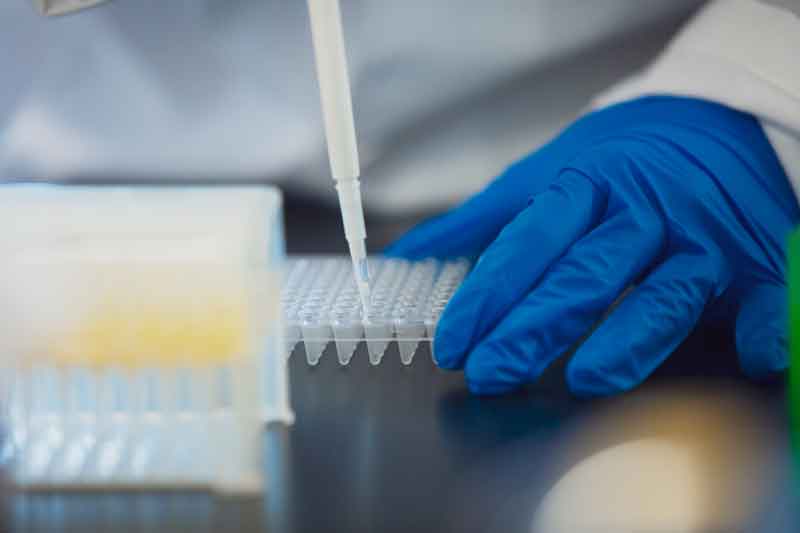
- Accuracy and Precision in Pipetting
- Conversions and Dilutions
- DNA, RNA, and Protein Extraction and Quantification
- PCR and RT-PCR Techniques
- Cell Culture
- Western Blotting
- Open Array Sequencing
- Translational Software
Logistics
- Course is offered during Spring Break
- Monday – Friday, 8 a.m. – 5 p.m.
- Elective course offering for in the Master of Science in Pharmacogenomics and the Master of Science in Nutrition and Nutrigenomics Program
- Prerequisites: none
Meals
- Breakfast: Most hotels offer continental as part of the room rate
- Lunch: Provided on-site by the class
- Dinner: On your own
Tuition & Fees
| PGx/NGx 592 (1 CH): Lab Techniques Intensive | Costs |
| Tuition | $935 |
| Fees | *$530 |
*This course includes an additional laboratory fee.
Travel and Hotel
MUFW has an agreed rate for students at these four surrounding hotels and students are encouraged to use the links below:
- Hilton Garden Inn Fort Wayne North – $129
- Home2 Suites by Hilton Fort Wayne North –$119
- Hampton Inn Ft. Wayne Dupont Road –$89
- Comfort Suites North Fort Wayne –$79
Faculty
Ann Savariar, MS
Melanie Felmlee, PhD
Meet the Faculty

Diane Calinski, Ph.D.
Chair and Professor of Pharmaceutical and Graduate Life Sciences
Fort Wayne 231

Melanie Felmlee, Ph.D.
Director of Pharmacogenomics, Professor of Pharmaceutical Sciences and Pharmacogenomics, Department of Pharmaceutical and Graduate Life Sciences
Fort Wayne 231

Noha Mourad
Assistant Professor of Pharmaceutical and Graduate Life Sciences
Fort Wayne

Shamma Rahman, Ph.D.
Assistant Professor of Pharmaceutical and Graduate Life Sciences
Fort Wayne 265

Ann Savariar-Drummond
Assistant Professor of Pharmaceutical and Graduate Life Sciences
Fort Wayne 232
You Might Also Be Interested In These Programs

Admissions and Application Information
Masters - Requirements
To be considered for the Master of Science in Pharmacogenomics, you must have:
- A bachelor’s degree in a science or science-related field; a master’s degree in a science or science-related field; or a relevant professional degree (medicine, dentistry, pharmacy, etc.). This degree must be equivalent to one conferred by a U.S. accredited institution.
- A minimum cumulative GPA of 2.7 on a 4.0 scale is preferred.
- A minimum science GPA of 2.7 on a 4.0 scale is preferred.
MS – Transfer Credits
A maximum of 8 credit hours of graduate credit taken at other accredited graduate schools may be transferred and applied toward the MS in Pharmacogenomics, provided that the credit is approved by the Program Director and Registrar. Credit cannot be earned through proficiency examinations.
Questions regarding transfer credits should be sent to pgx@manchester.edu.
Masters - Application Process
Applications to the MS in Pharmacogenomics should be submitted through the Pharmacy Graduate Application Service (PharmGRAD). A completed PharmGRAD application is required for admission consideration, including a personal statement,CV/resume, and transcript from all institutions attended. Applicants must report all institutions attended on the PharmGRAD application and request that transcripts be sent directly from each institution to PharmGRAD.
Applicants who studied outside the United States must order a course-by-course foreign credit evaluation from World Education Services (WES) and have it sent directly to PharmGRAD.
The application deadline for the on-site MS in Pharmacogenomics is April 15th for domestic applicants and February 15th for international applicants.
Application deadlines for the online MS in Pharmacogenomics is December 15th for Spring admission, April 15th for Summeradmission and July 1st for fall admission. The program is offered 100% online and is open to international students.
Certificate - Admissions Requirements
To be considered for the Pharmacogenomics Graduate Certificate, you must have one of the following from a regionally accredited institution:
- A bachelor’s degree in a science or science-related field
- A master’s degree in a science or a science-related field (eg. Geneticcounseling); or
- A relevant professional degree (medicine, pharmacy, dentistry, etc.). The degree must be from a regionally accredited institution.
A minimum cumulative GPA of 2.7 on a 4.0 scale is preferred. A minimum science GPA of 2.7 on a 4.0 scale is also preferred.
Graduate Certificate - Application Process
Applications to the Pharmacogenomics Graduate Certificate should be submitted through the Pharmacy Graduate Application Service (PharmGRAD). A completed PharmGRAD application is required for admission consideration and must include a personal statement, CV/resume, and transcripts from all institutions attended. Applicants must report all institutions attended on the PharmGrad application and request that transcripts be sent directly from each institution to PharmGRAD.
Applicants who studied outside the United States must order a course-by-course foreign credit evaluation from World Education Services (WES) and have it sent directly to PharmGRAD.
Application deadlines for the Pharmacogenomics Graduate Certificate are December 15th for spring admission, April 15th for summer admission, and July 1st for fall admission. The program is offered 100% online and is open to international students.
International Students
International Admissions
International students may be eligible for the on-campus Master’s of Pharmacogenomics program, and may also be eligible for the online Master’s and Pharmacogenomics Graduate Certificate programs- (depending on Country of Residence).
Application:
All international applicants must apply through the PharmGRAD. A completed PharmGRAD application is required for admission consideration, including a personal statement, CV/resume, and transcripts from all institutions attended.
Transcripts:
Applicants who completed their prior degree(s)/studies outside the United States will be required to submit a course-by-course foreign credit evaluation report from World Education Services (WES) for each international institution attended directly to the appropriate CAS.
Verified copies of all collegiate transcripts:
- Step 1: Enter all institutions attended, domestic and international, in your PharmGRAD application.
- Step 2: Please follow the steps outlined within the application process to order this evaluation.
- Information about WES can be found at www.wes.org. Students are responsible for payment of fees to WES (not Manchester University) for this service.
English Proficiency:
International applicants must be able to read, speak, write and comprehend rapid idiomatic English. We do not offer ESL instruction. Therefore, the TOEFL or IELTS exam is required of all students whose language of instruction is not English. The following are minimum guidelines used to determine sufficient test scores for admission:
TOEFL paper-based test = 550
TOEFL iBT = 79
IELTS = 6.5
Testing locations and dates for these exams may be found on their web sites:
Test results must be entered into your PharmGRAD application and sent to PharmGRAD.
Important: Applicants who were instructed in English may still be asked to submit a TOEFL or IELTS exam result in order to assess English proficiency.
Evidence of financial support:
Students must be able to show their ability to pay for their program studies in the United States. Students may self-fund their education or obtain a financial sponsor. Students with a financial sponsor must complete the Affidavit of Financial Support and return the document signed by the student’s sponsor to the Office of Graduate Admissions with proof of adequate funds to support you for at least one year. Such proof includes bank statements, employer testimony of salary, or government support letters.
Statement of Non-Discrimination in the Admission Process
Manchester University is committed to non-discrimination in the admissions process. The University does not discriminate on the basis of national origin, ancestry, race, color, age, sex, gender identity or expression, sexual orientation, familial status, religion, disability, physical characteristics, or veteran status in admissions including its admission decisions and scholarships or loan awards.
Certified copies of marks, grades, and transcripts, if the degree(s) were received from institutions outside of the U.S.
Manchester will not accept transcripts directly submitted by students or institutions. All international transcripts must be submitted for evaluation to World Education Services. WES will then send Manchester University a copy of their evaluation. There is a fee for this evaluation that the student is in charge of paying and the evaluation can take 2-4 weeks. If you are transferring from a university outside the U.S., you also must have the transcript evaluated by World Education Services. Admission and transfer of credits cannot be finalized until we receive the report from WES.
Specific Disclosures by Jurisdiction
Ontario, Canada: Manchester University is a private university located in Indiana, United States. Manchester University is not an Ontario university and is not authorized by the Ontario Ministry of Colleges and Universities to grant degrees in Ontario. Online programs are offered by Manchester University from the United States and any degrees are conferred by Manchester University in Indiana. Further, Manchester University’s degrees may or may not satisfy Ontario’s specific requirements for professional registration/ licensure. Students should consult with appropriate professionals/ agencies prior to enrolling in the program at Manchester University.
Let's Connect
We are ready and waiting to answer all your questions about our Master of Science in Pharmacogenomics!
For questions or more information, contact us at gradadmissions@manchester.edu or call 260-470-2703
Costs and Financial Aid
The cost of attendance is designed to provide students with an accurate projection of reasonable cost associated with attending Manchester University. The cost of attendance reflects reasonable cost that a typical student with a modest lifestyle may incur to attend the University. The cost of attendance does not represent a student’s actual charges/experience. The exact cost will vary.
FAQs About the Pharmacogenomics Degree
What is Pharmacogenomics?
Pharmacogenomics (PGx) is the study of how an individual’s genetic profile affects their response to medications. This evolving science is the cornerstone of personalized medicine, aiming to optimize drug efficacy and minimize adverse reactions based on genetic makeup. Through pharmacogenomic testing, clinicians can identify gene-drug interactions that guide more precise prescriptions—improving outcomes in clinical practice and reducing trial-and-error in medication management.
This field plays a pivotal role in advancing personalized healthcare. By integrating human genetics with pharmacology, pharmacogenomics supports clinical implementation strategies that are transforming the pharmaceutical industry. It is especially critical for patients with complex medical histories or those who have experienced treatment resistance or adverse drug events.
Manchester University’s pharmacogenomics program prepares students to lead in this growing field. Students gain hands-on experience and foundational knowledge needed for real-world settings, learning how genetic testing intersects with medicine, pharmacy, and data analysis. The program’s curriculum makes it ideal for those with a background in biochemistry, medical genetics, or pharmaceutical sciences.
As precision medicine continues to evolve, the demand for professionals with a pharmacogenomics degree will increase, fueling career opportunities in clinical pharmacogenomics, genetic counseling, laboratory analysis, and research
What makes Manchester’s PGx program unique?
Manchester University was the first institution in the United States to offer a dedicated Master of Science in Pharmacogenomics, establishing it as a pioneer in precision medicine education. Since its launch in 2015, the program has gained national recognition for its innovative approach to genetic-based healthcare training.
What sets Manchester’s pharmacogenomics program apart is its blend of personalized instruction, real-world lab experience, and academic leadership. Students benefit from a low student-to-faculty ratio (10:1), allowing for individualized mentorship throughout the program. Faculty are active researchers and practitioners in pharmacogenomics, clinical implementation, and pharmaceutical sciences—offering insight into both theory and practice.
The program is flexible, offering options for on-site and online, dual pathways for PharmD students, and a 3+1 BS/MS pathway. Our online pathways are 100% online and asynchronous with an optional one-week on-campus pharmacogenomics laboratory intensive elective. Our on-campus pathway provides students with extensive laboratory and research experiences.
Regardless of delivery format, all programs emphasize personalized healthcare, real-world training, and preparation for clinical implementation in healthcare settings. Students graduating from the program join a network of professionals driving innovation in genomic medicine, making Manchester’s PGx program a top choice for aspiring leaders in the field.
Is hands-on experience included in the PGx program?
Hands-on experience is one of the defining features of Manchester’s on-campus pharmacogenomics program. From the first semester, students engage in laboratory experiments using the tools and technology employed in modern clinical pharmacogenomics and pharmaceutical sciences. The program’s faculty guide students through lab protocols, data analysis and interpretation of genetic testing results bridging classroom knowledge with experimental application.
For students in the online program interested in gaining hands-on laboratory experience, we offer a one-week laboratory intensive (PGx 592) on-campus during spring break (open to students within the United States only). This one credit hour elective introduces modern pharmacogenomic techniques and data analysis with students actively engaged in laboratory experiments.
How are the courses formatted? Do the courses have video or audio lecture, or other interactive pieces?
We use the learning management system Canvas to administer all courses, whether online or on campus. Assignments, quizzes, and exams are all submitted through Canvas.
Our on-campus courses involve lectures, reading assignments, discussions, projects, and hands-on experiments.
Our online courses have short lecture videos, reading assignments, discussions, and projects. Discussions are interactive and may involve student-generated video presentations. Some courses have live review sessions prior to exams, which are recorded and shared for those who cannot attend.
Are students assigned to a faculty advisor/mentor?
All students are assigned to a faculty advisor and a student success advisor when they join the program.
What academic support is available if I am struggling in a class?
Contacting the course instructor is the best place to start as they will be able to provide specific instructions for improvement related to the course content. Additionally, your Student Success Advisor provides academic resources and personal mentorship to overcome challenges and improve study skills.
How long does it take to complete the MS and Graduate Certificate in Pharmacogenomics?
Our on-campus MS in Pharmacogenomics is designed to be completed in just one year of full-time study. Students benefit from a summer semester start and complete the program within three traditional semesters (summer, fall, and spring).
Our online MS in Pharmacogenomics is designed to be completed in two years. Courses are 7 – 8 weeks in duration with students typically take 2 course per semester. The online program is flexible with summer, fall, and spring semester start dates. Students may complete the program in a shorter or longer time frame depending on their specific needs and discussion with the Director of Pharmacogenomics
The Graduate Certificate in Pharmacogenomics is an online program designed to be flexible with students taking 1 to 2 courses per semester. The program can be completed in a few as three semesters, but typically students take 4 to 5 semesters to complete the coursework. Students meet with the Director of Pharmacogenomics to build a course plan that fits their needs.
Can I complete the online MS in PGx part-time?
We strongly recommend that the online program is completed at a part-time pace with students averaging 5 – 8 credit hours per semester. The online program is designed for students that have additional obligations in their life (ie. work, family, etc), which makes a full-time degree difficult. The pace of the online program allows students complete the degree requirement in 2 years and continue their lives while advancing their education.
Does the coursework have to be completed within a specific time frame?
Pharmacogenomics is a rapidly evolving field. To ensure our graduates have received the most up-to-date training, we require all course work to be completed within 5 years of the students start date in the program.
Can I transfer from the Graduate Certificate to the MS program?
Students can transfer from the Graduate Certificate to the MS in Pharmacogenomics at any time during the program, provided they are in good academic standing. Courses taken during the Graduate Certificate apply towards the MS degree.
Do I need to take the GRE to be considered for admission to the MS or Graduate Certificate?
The GRE is not required for admission to the MS or Graduate Certificate programs.
Is financial aid available for PGx students?
Financial aid is available for eligible students. Students can apply for federal student aid and are encouraged to explore scholarship opportunities specific to healthcare and pharmaceutical sciences.
Manchester’s Student Financial Services works closely with students to navigate tuition costs, estimate funding options, and understand timelines for disbursement. Manchester offers resources tailored to your needs. This includes assistance for international students, and those enrolled in dual degree pathways or the 3+1 BS/MS.
Does Manchester University offer technical support for online Master’s students?
Students can request technical support via several mechanisms. The Manchester University ITS Help Desk is available Monday to Friday from 8 am to 5 PM EST and can be reached at 260-470-5454.
Outside of business hours requests can be submitted using an online form, and our learning management system, Canvas, provides 24/7 support.
Master of Science in Pharmacogenomics Program Outcomes
Program Outcomes
Cutting Edge Career Opportunities
With an MS in PGx, you will be ready for employment in the genetic testing and pharmaceutical industries as an applied scientist who can work on all aspects of pharmacogenomics testing including sample accessioning and preparation, sample analysis, data storage, data mining and reporting. You will also be equipped to pursue a Ph.D. or a professional degree in fields like medicine, pharmacy or dentistry. This program can also expand your capabilities in professional fields, such as genetic counseling.
PGx graduates, graduating classes of 2017-2021, report an 89 percent success rate after graduation.
Graduate results were updated in May 2022. Results are based on 100 percent knowledge rate (the percent of graduates for which the institution has reasonable and verifiable information concerning the graduates’ post-graduation career activities). Post-graduate success is defined as employment or enrollment in a program of continuing education.
Accreditation
The Manchester University Master of Science in Pharmacogenomics Program and Graduate Certificate in Pharmacogenomics are accredited by the Higher Learning Commission of the North Central Association of Colleges and Schools.
Non-Discrimination in the Admission Process
Manchester University is committed to non-discrimination in campus life. The University does not discriminate on the basis of national origin, ancestry, race, color, age, sex, gender identity or expression, sexual orientation, familial status, religion, disability or veteran status in admissions or any area of campus life, including its educational programs, scholarships and loan awards, residence life programs, athletic programs, extracurricular programs, promotion and tenure policies and practice, and alumni affairs.
Manchester University is committed to carry out the provisions of Section 504 of the Rehabilitation Act of 1973 and the Americans With Disabilities Act, which provide for accessibility of University programs to the physically disabled.